SITE INDEX
How To Order
Catalogue
Products & Price List
Manuals & Repairs
Specials & Surplus
New for 2008
The Olde Antenna Lab Applicaton Notes
ATV DX Calc. - Records
Seeing Your First Picture
Radio Control Vehicle ATV
Balloon ATV
Rocket ATV
ATV Repeater System design
Emergency Comm ATV
Legal Uses & FCC Rules
ATV related Links
Plug and Play 70cm ATV

P. C. Electronics
Tel: (626) 447-4565 m-th 8am-5:30pm pst (UTC - 8)
2522 Paxson Lane Arcadia CA 91007-8537 USA
Tom (W6ORG) & Mary Ann (WB6YSS)
Email:                
The Leaders in Amateur Television Equipment
Since 1965


                GET THE ATV BUG in 2008!


AMATEUR TELEVISION - ATV
Ham Radio with Vision
Make A Portable Emergency Communications ATV "Go Kit"
See our EMCOMM Application Note

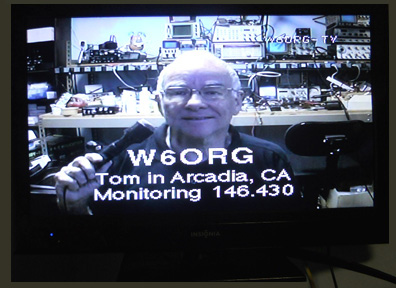
Any FCC Licensed Technician Class or higher Amateur Radio operator can transmit and receive live action color video and sound to other hams that looks and sounds just like commercial broadcast TV with our time proven equipment. Hams should be seen as well as heard.

        If you are in the USA and not a licensed Radio Amateur, see What Is Ham Radio and Getting a Ham License on our Application Notes page and join the fun. Our products are sold to licensed Radio Amateurs verified in the Callbook or FCC data base, and for legal applications in the USA. If outside the USA, your countries laws and licensing may be different.

        You don't need a computer or any interface box like SSTV or Digital TV; This is live full motion color video and audio the same as you are used to seeing on analog broadcast TV. Show the family off to other hams.
It's FUN & Easy to get on ATV!


ATV, Where to Start
Download file ATVStart.pdf then print out and pass out to your ham club or friends.
        Amateur Television, ATV, is fun and easier than you might think to get on with all kinds of applications - scroll down.
Besides sending and receiving live action color video between home ham stations on the 420 MHz band much in the way you are probably used to with voice on two meter FM, there is:

  • Showing critical locations to local emergency service
    groups or back to the EOC during ARES or RACES
    Homeland Security drills or actual disasters, parades,
    races, and other public service events.
  • Televising live or from tape your ham radio club meetings
    to those who could not make it in person.
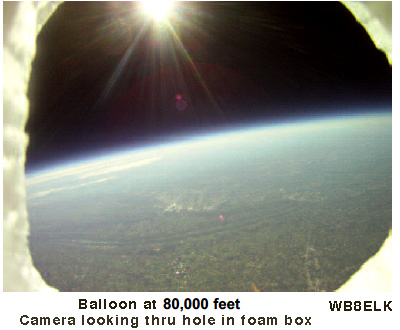
  • Seeing the edge of space from amateur balloons or
    rockets as high as 100,000 ft.
  • Getting a pilots view from a camera in a R/C model
    aircraft or real airplane.
  • Seeing Space Shuttle and ISS video and audio if some
    one is repeating it from sat receiver or web site, and more.

Transmit incident scenes back to the EOC in live full motion color video and sound. ATV lets ICS supervisors more quickly and efficiently assess the situation and allocate resources. Shown is inside the San Bernardino County CA EOC watching a fire on the reverse slope of a mountain via ATV. - Scroll down


Televise Ham Club Meetings
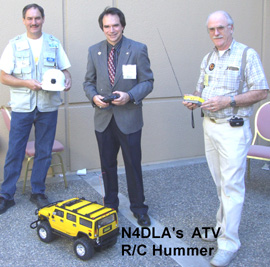
demos and presentations, like the R/C aircraft and car ATV pictured above, can be televised simplex or through a local ATV repeater live or transmitted later from video tape to those who could not personally make the meeting.


Public Service Events
Events like the 10K Run shown here televising a busy street crossing in front of the Pasadena CA Rose Bowl back to the run organizers and police so they can better see and utilize resources are ideal for ATV. Also, this mode is great for parades, Triathlons, Hazmat, remote damage assessment, weather radar, etc., for ARES & RACES emergency communications groups. Live, full motion color video communicates much more information accurately and faster than can be done on voice or digital modes only.

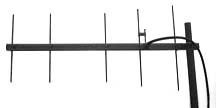
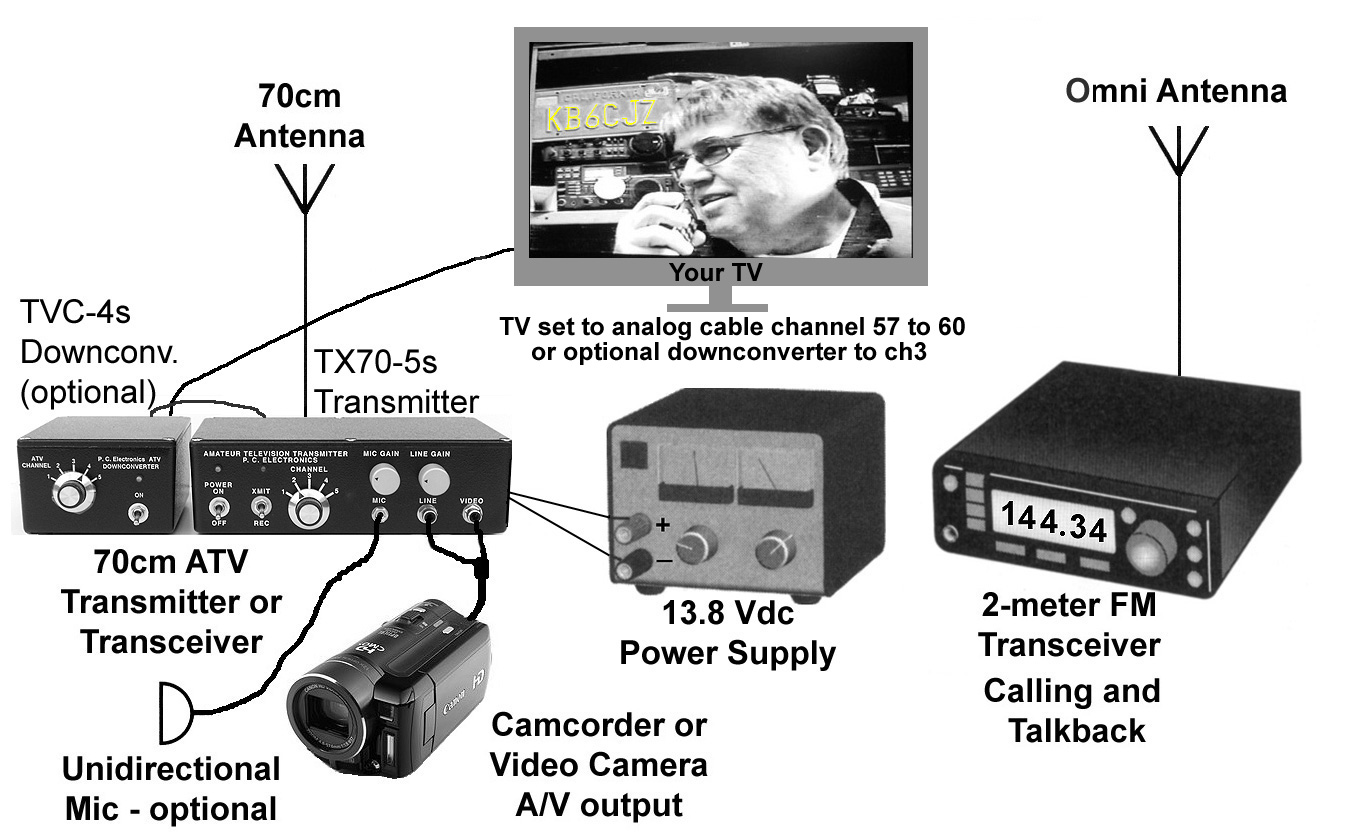
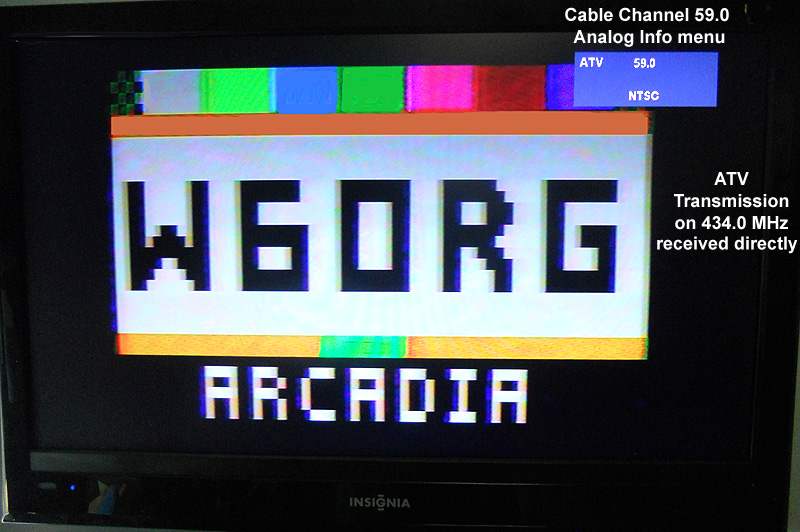
        To see your first picture it may be as easy as tuning your cable ready TV to cable channel 57 thru 60 and connecting it to a good outside 70 cm antenna of the same polarity as is used in your area by ATVers. Later, for best DX, get one of our TVC-4S downconverters. We suggest the OAL 5L-70cm beam, but check out the low cost homebrew antennas - It doesn't get any cheaper or easier than that to enjoy another of the many modes in Amateur Radio. Make sure your TV tuner is switched to cable channels when you try it - cable channels are on different frequencies than over the air UHF TV channels. Unlike slow scan TV (SSTV) or satellite digital TV, ATV standards are the same as broadcast TV and your camcorder so your TV set is your receiver without the need of any computer or other black box interface.

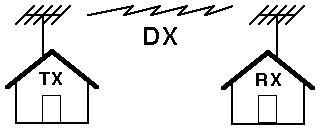
        The 70cm 420-450 MHz amateur band (430-450 MHz above the A line) is the lowest frequency Amateur band with enough bandwidth to support a standard 6 MHz AM ATV channel and you only need a code free Technician class license or higher to transmit. Also since the lower the frequency, the farther the distance, given the same power and antenna gain, this is where 98% of ATVers operate. The 902-928 MHz band goes half the distance and so on as you go higher. The 70cm band is also lowest cost, easiest to get on and can best be seen between antennas with line of sight - no obstructions. Line of sight between the two antennas is the only predictable distance given antenna gains and transmitter power - see ATV DX below. Non-line of sight just has to be tried and antennas moved to find the best location. 2-meter simplex voice contact is a good indicatior that a path might be possible.

        Contact a local ATVer on two meter voice (144.340 or 146.430 MHz typically) and have them send a picture your way. They can tell you the local frequencies, antenna polarity, net times, etc. If you don't know of an ATVer in your area, call or email us with your postal zip code and we will try to put you in contact. Also check the ARRL Repeater Directory for any ATV repeaters that might be in your area.
The transmitting ATV station talks on the sound subcarrier which comes over the TV speaker, and all those watching can talk back on two meters at the same time just like on a telephone. This is great for talking in beam alignment, commenting on video content, etc.

        Cable channel 57 is 421.25 MHz, the most common inband ATV repeater output, and 60 is 439.25 MHz, the highest frequency used in the band generally for repeater input and simplex DX. Over the air broadcast TV and cable TV channels, spaced in 6 MHz increments, are amplitude modulated (AM) video with a 4.5 MHz FM sound subcarrier. The automatic frequency control, AFC, in the TV set can usually lock up to within +/- 2 MHz of the video channel carrier frequency. So all the commonly used 70 cm ATV frequencies (421.25, 426.25, 427.25, 434.0 and 439.25 MHz) can be locked onto and seen with most cable ready TV sets if the tuner is switched to cable. Note that cable channels are on different frequencies from channel 14 up than over the air UHF channels and should not be confused. UHF broadcast over the air channel 14 is 471.25 MHz and 57 is 729.25 MHz, well above the 70 cm ham band.

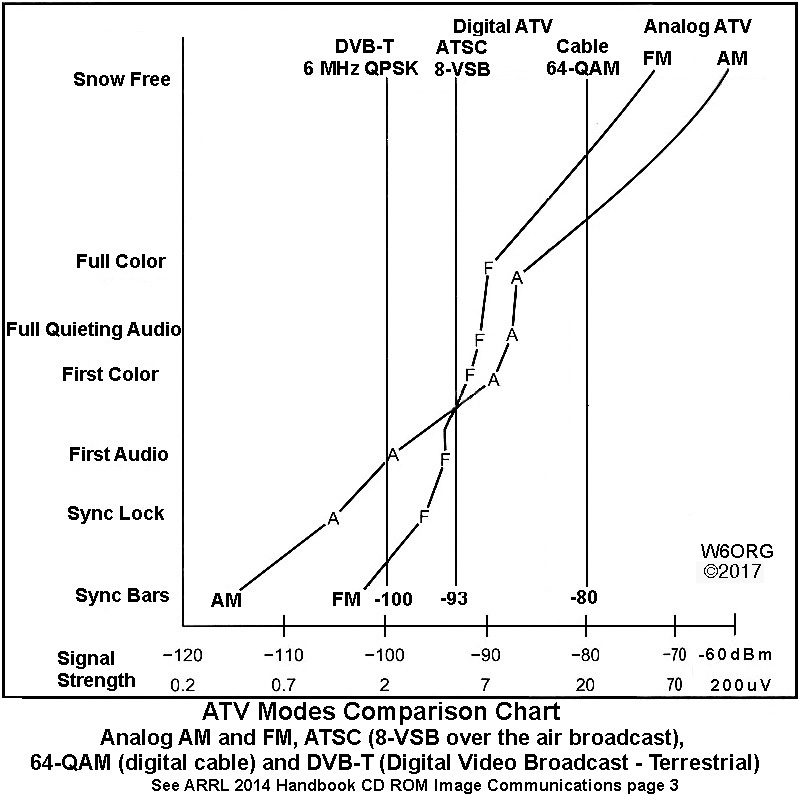
        Any code free Technician class licensee can get on ATV. ATV frequencies work best with an unobstructed line of sight path between the transmitting and receiving antennas. So the antenna and height is the most important part of the ATV station. Antennas need to be made for the 70 cm band, preferably as high of gain as possible and the same polarity as is standard in your area. Low loss 50 Ohm coax like Belden 9913 or LMR400 with N connectors are also a must as it takes 150 to 200 microvolts into your receiver for a snow free picture and you don't want to throw RF away unnecessarily.

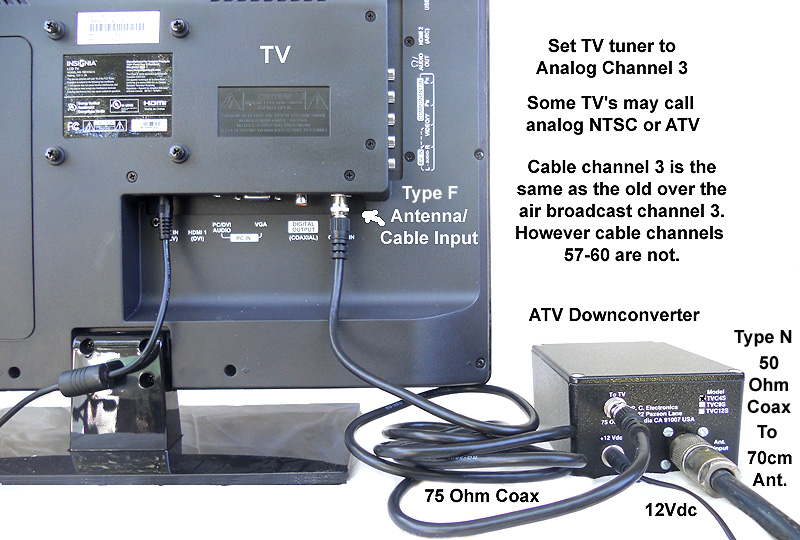
TVC-4S ATV Down Converter tunes the 5 standard ATV frequencies - 421.25, 426.25, 427.25, 434.0 and 439.25 MHz - in the 420-450 MHz ham band down to TV channel 3 or 4 if you just want to try receiving but be right on frequency with more sensitivity than a cable TV set. The TVC-4S contains a low noise HJ-FET preamp and GaAsfet mixer. The TVC-4S down converter connects between your 70cm antenna and TV set. Comes with 115 Vac wall plug power supply, or you can run from external 11 to 15 Vdc at 100 ma. Type N 70cm 50 Ohm antenna jack and type F 75 Ohm output to TV.....$149


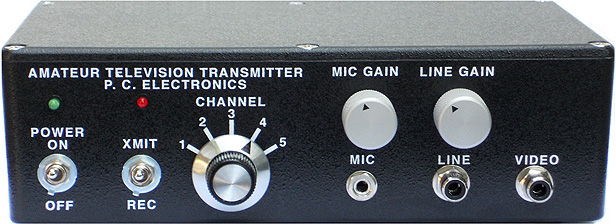
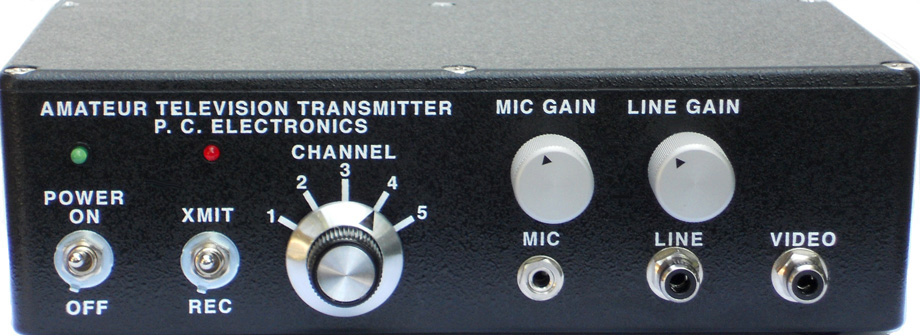
RTX70-1s new 1 watt pep Plug & Play ATV 70cm Transmitter...$399

        Any camcorder or camera can simply plug its composite video and line audio into the ATV transmitter. The applied video can be color or black and white - what ever you plug in is what you get out. Composite NTSC video is the standard A/V output in the USA for camcorders.

CB-35 480 line High Resolution
Color camera..$189


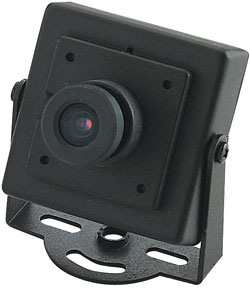
LB1000..$79 color camera from P. C. Electronics. 1.5 inches square, 3 oz, 420 line resolution, built-in mic, runs on 8 to 14V@40ma.

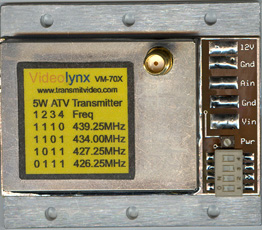
       After you see your first picture, you will want to improve your reception for DX or get less snow with one of our downconverters and high gain beams - see our catalogue page 3. Then to transmit, we have the RTX70-1s 1 Watt pep ATV Transmitter with which you can add the Downeast 7025PA or Mirage D26N linear amp for 40 - 50 Watts pep. We also offer the 1 Watt built and tested boards for those who want to package their own systems or use them for portable, R/C, rockets or balloon ATV - see catalogue page 2 and page 5. With the RTX70-1s ATV transmitter plus 7025PA or D26N amplifier, 14 dB of gain from DSFO ATV-25 beam antennas and coax loss at both ends you can send and receive snow free video over 100 miles if line-of-sight between the antennas. However, getting line of sight is the trick or waiting for temperature inversion skip. Non-line-of-sight is not predictable and just has to be tried. How well you do on 2 meter simplex is a good indication that you have an ATV path if the signal is strong - See ATV DX Records.

        As an alternative there are many small low cost color or black and white cameras available now that are made for computers or security under $200 that can be used at the home station, mobile, portable, R/C, balloon or rocket ATV. We stock the CB-35 (left) high resolution color camera for $189 primarily for home use and the LB1000 color camera for $79 and is ideal for R/C, hat cams or even the shack.

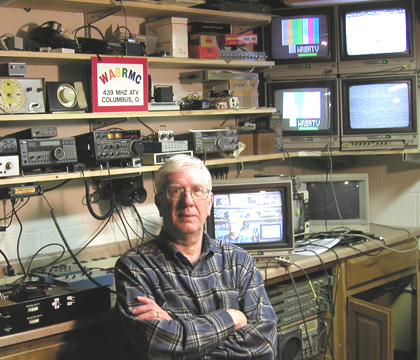
        Identifying your call letters is the same as any other mode in Amateur Radio - every 10 minutes during long transmissions and at the end of every transmission. With ATV, You can simply speak your call on the sound subcarrier or the easiest is to make a sign with your call letters on it that can be plainly seen on the wall behind you in the shack. If you want to get fancy, insert in the video cable between the camera and transmitter one of the OSD video overlay boards with your call. You can even overlay GPS data - latitude longitude, heading, speed, altitude and time - along with with your call letters as shown in this R/C aircraft ATV photo below right.


ATV DX Chart
                 

To find the distance, go across your antenna system Total gain dB to your your transmitters peak envelope power diagonal line and then go down from that point to find the snow free (40 dB video to noise ratio or P5) line of sight distance.

Total gain in dB = sum of Transmitter antenna gain in dBd (gain over a dipole) plus Receiver antenna dBd gain minus transmitter and receiver coax losses.
If for the 900 MHz band, subtract 6 dB; if 1200 MHz band, subtract 9 dB or see the 23cm chart; if 2400 MHz band subtract 15 dB; if 4 MHz deviation FM ATV add 12 dB; if your downconverter noise figure is more than 2 dB, subtract each dB above 2 (cable TV sets are about 6 dB NF). For power levels inbetween the diagonal lines, add or subtract dB's - ie. add 3 dB each time you double the power.

Example #1 - Home Stations:
RTX70-1s transmitters plus optional DEMI 7025PA amps, TVC-4S downconverters, DSFO-ATV25 16 dBd beams and 100 ft Belden 9913 or Times LMR-400 (2.5 dB loss) at both ends:
16 + 16 - 2.5 - 2.5 = 27 total gain. 27 dB intersects with the 20 W line at 140 Miles and 1W line at 30 miles.
The hard part is getting line of sight for 140 miles - see line of sight below - or waiting for tropo openings. See ATV DX Records.

Example #2 - Public Service Events:
RTX70-1s 1 Watt pep ATV Transmitter, TVC-4S downconverter, direct short coax connections of approximately 1 dB loss, OAL 5L-70cm 8 dBd beams at both ends as is typical for public service events:
8 + 8 -1 -1 = 14 Total gain. 14 dB intersects with the 1 W line at 7 miles.

Example #3 - Balloons:
Using the same 1W TXA5-RCs transmitter board as is used in the RTX70-1s and TVC-4S downconverter as in example #2, but a OAL 70cm Wheel on the balloon and OAL 7CP-70cm circular polarized beam on the ground, you would expect snow free P5 video up to 60,000 ft and P4 at 120,000 ft depending on winds aloft moving the vehicle horizontally away from you. These two antennas would add about 3dB to the Total gain given in example #2.

Example #4 - R/C Around a Flying Field:
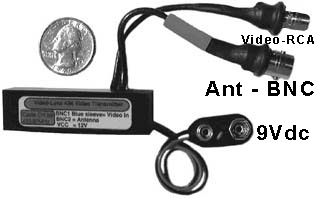
Videolynx 434 50-100 mW transmitter, TVC-4S downconverter, vertical dipole in R/C aircraft, home brew ground plane antenna to receive, direct short coax connections of approximately 1 dB loss:
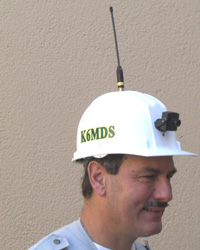
0 + 2 - 1 -1 = 0 dB Total Gain. 0 dB intersects with the 50 mW line at 1/3 of a mile which is great for around a R/C flying field, hamfest, demo ATV at a ham club, use a hard hat cam or public service event. If a OAL 5L-70cm 8 dBd beam were added at the receiver, the DX would go to almost one mile.

Example #5 - Point to Point Links:
Videolynx Z23B 2 Watt 23cm FM ATV transmitter, 23/33FMR-3 FM ATV receiver, 80 ft of Belden 9913 coax to Directive Systems 2424LYRM 16 dBd Yagi's at both ends:
16 + 16 - 4 - 4 = 24 dB for the antennas and coax. 24 + 3 - 9 + 12 = 30 dB total from the addition of 3 dB so the 1W line can be used, less the 1200 MHz band plus the FM advantage which ends up giving 40 miles.

For P4 AM video (a little snow in the picture) double the distance or add 6 dB for each lower P unit. P3 is where color starts to drop out. FM ATV drops off much more rapidly. Given the Videolynx 434 50 mW example above, P4 would then become 2/3 of a mile and color dropping out around 1.3 miles - still very useable video and sound. It is not surprising then that 50 mW transmitters have keyed up repeaters up to 10 miles away with a P1.

Line of sight means absolutely no obstructions - if you were to have a high power telescope pointed down the antenna boom, can you see the other antenna?
RF line of sight in miles over flat terrain is equal to the square root of 2 times the antenna heigth in feet. See graph at right.
For example, if one tower is 50 ft ( 2 x 50 = 100, sq root of 100 = 10 miles ) and the other end is 100 ft ( 2 x 100 = 200, sq root of 200 = 14.1 miles) then the expected line of sight distance would be 10 + 14.1 = 24.1 miles.

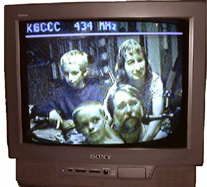
This is typical for most local simplex operation, but can be much further during temperature inversion TROPO over the horizon skip conditions - KH6HME on the big island of Hawaii was seen in Southern California by KC6CCC in July 11, 1994, a DX of 2518 miles using a 14 dBd beam, TVC-4G downconverter and TV set - See ATV DX Records
Line of sight is predictable for DX but non line of sight just has to be tried as the obstruction attenuation varies greatly - move the antenna a few feet at a time and try to find a "magic spot".
See our ATV DX Variables application note for more detailed information


        For more info on ATV, we suggest reading the ATV section of the 1995 -2008 ARRL Handbook for Radio Communications starting in chapter 12 page 46 or chapter 9 page 38 (W6ORG wrote it) in the current book. It will give you all the basic information and background for this visual mode of ham radio.

The ARRL Repeater Directory lists all the coordinated ATV repeaters in the country - see if one is in your area.

Amateur Television Quarterly magazine - ATVQ - is also a source of continuing ATV information.

        There is an ATV remailer where you can ask questions, receive info, hear about temperature inversion DX openings and keep up on ATV happenings around the country - it is free.
        To subscribe, just send an email to:
            majordomo@www.kd4moj.org
            In the body of the message only put: subscribe atv
This will automatically send you any message sent to the remailer from other ATVers. You can also find local ATVers and clubs usually on this remailer. To send a message to the group email to: atv@www.kd4moj.org

Check out the other ATV application notes on page 3 of this web site and also our catalogue and list of products and prices on page 4 of this web site.

See our ads in QST, ATV Quarterly, and Worldradio Magazines.

Go to page:
2. ATV Transceiver and Downconverter.
3. ATV Application Notes, Information and basics, links, licensing and FCC Rules.
4. Products, Prices and Catalogue downloads.
Specials & Surplus

Page 1 Page 2 Page 3 Page 4 Specials


Information about this server
The location of ths page is www.hamtv.com/index.html
copyright ©2008 artsci inc. all right reserved...